I often get asked in my sessions “What does TRX mean? What does it do? How can it help us? What are some common examples of movements?”
Well, you are in luck because I am about to answer all of your questions, and if not, then you can make your way into SPENGA Littleton and ask me about anything I didn’t cover or join us in one of our TRX workshops.
The TRX System, also known as Total Resistance Exercises, is a piece of equipment developed by former U.S. Navy SEAL Randy Hetrick. He created it so that you can workout on the go and get a full body workout anywhere and anytime. TRX combines your endurance, strength and power workouts with literally one piece of equipment. To keep it simple, the TRX uses your body weight, angles and unilateral movements to help develop strength, balance, flexibility and core stability simultaneously. It can often be a safer option for a lot of clients. Another way to explain it is that it leverages gravity and the user’s body weight to complete the exercises. What I personally love (and this is a blog, so opinions are ok!) is clients at all fitness levels and all different fitness journeys can benefit from it. Now that we know what it is, let's move onto some basics.
I have had some members ask me what’s the most important thing to remember when using the TRX? To be fair, it's a bit tough to pick just one, but your starting position is very important and your body positioning. Remember that every movement you do should be engaging your core and creating a mass within your body. For instance, if you are doing a high row (if you are near a TRX try it after you read this), I would cue it like this:
- Straps should be at the short length
- Face your anchor point, Shoulders down and back, Think about putting your lats in your back pockets
- Walk towards the anchor point angling your body until the straps are taught and even. Think of it as you are in a suspended plank position.
- Before you start your movement, think about tucking your pelvis under, squeeze your glutes (pinch a penny), engage your quads and finally your core. Maybe think of it as your body is a surfboard, not a wet noodle al-dente style. You are creating a mass within your whole body, with no space
- As you pull your chest to the anchor point your body should stay in that plank position, or surfboard position. Thumbs come to your armpits and elbow are in-line with your shoulders, and repeat!
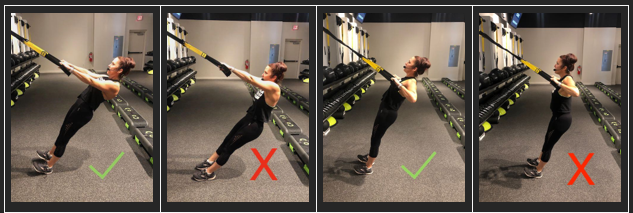
That is just one movement, but the point is setting the client up for success starts at the beginning.
The reason TRX has become so popular both inside and outside of gyms and studios, is you can use it to help with so many different avenues of your fitness journey. It is easy to install in a variety of places. It is a great way to work the “inside muscles'' or stabilizers. It is an effective tool to figure out awareness of your body and strengthens your ability to move better. It is effective in alleviating pressure on your joints when used correctly.
TRX can help with sports movements as well. When practicing explosive movements on the TRX (sprinter start, superman, burpee, and others) it will help with running, biking and swimming. It is also highly effective for sports with rotational movements that occur with golf, tennis, baseball and of course the sport of life.
Suspension straps have slowly made their way into big box gyms, boutique fitness, home gyms, outside gyms, suitcases and it all started with a Navy Seal wanting to get his workouts in on the road. It really is an amazing tool that can hit any muscle group you want. TRX straps are user friendly and are appropriate for all fitness levels, so I challenge you all to come to the next workshop we have at SPENGA, and grow your fitness knowledge on one of the best pieces of fitness equipment out there!
For demonstration on these movements, please check out our videos on our SPENGA Littleton YouTube channel!